 What's New?
Document Actions
Computational Genome Annotation
The group’s major contribution to Genomics has been the development of a novel and very accurate gene finding system, called mGene, that uses the latest advances in Machine Learning.
Research Projects
- Gene Finding
-
The group’s major contribution to Genomics has been the development of a novel and very accurate gene finding system, called mGene, that uses the latest advances in Machine Learning. Our system outperformed other gene finding systems in a competition on nematodes (on average over the evaluation criteria). We have recently extended this system to additionally take advantage of direct transcriptome measurements, which leads to an improved prediction performance. - Protein Subcellular Localization
-
- We use "Multiple Kernel Learning" (MKL), an extension to support vector machines (SVMs) to combine and select diverse data sources, to predict the subcellular localization of proteins.
- Domain Adaption for Genomic Sequence Analysis
-
Supervised learning methods are machine learning techniques that use a set of labeled training examples (x_i; y_i) to infer a model that generalizes well to unseen examples x, and therefore allows to make predictions y for these instances. One of the underlying assumptions is that training and test data are drawn from the same distribution. However, in real-world applications, and specifically in computational biology, one often faces the situation that little or no training data is available for the problem of interest (the target domain), whereas a large corpus of labeled data exists for a related but different problem (the source domain). While it is highly desirable to exploit the labeled source data points to improve performance on the target domain, it clearly violates the basic assumptions of machine learning. Methods to tackle this so-called domain adaptation problem have recently caught increasing attention in the machine learning community and are subject of consideration in this work. In particularly we examine their effectiveness for the problem of splice site prediction across different organisms with varying evolutionary distance. 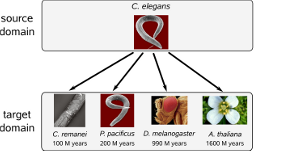
- Inference of Alternative Splicing
-
- Transcription Start and Stop Detection
-
We develop new methods for finding transcription start sites (TSS) of RNA Polymerase II binding genes in genomic DNA sequences. Employing Support Vector Machines with advanced sequence kernels, we achieve drastically higher prediction accuracies than state-of-the-art methods. 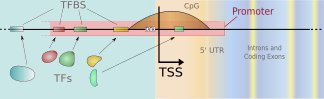
Publications
-
Rätsch, G, Sonnenburg, S, Srinivasan, J, Witte, H, Müller, KR, Sommer, R, and Schölkopf, B (2007).
Improving the C. elegans genome annotation using machine learning
PLoS Computational Biology, 3(2):e20.
http://compbiol.plosjournals.org/perlserv/?request=get-document&doi=10.1371/journal.pcbi.0030020
 Printable file
-
Schweikert, G, Sonnenburg, S, Philips, P, Behr, J, and Rätsch, G (2007).
Accurate splice site prediction using support vector machines
BMC Bioinformatics, 8(Suppl. 10):S7.
http://www.biomedcentral.com/1471-2105/8/S10/S7
Printable file
-
Sonnenburg, S, Zien, A, and Rätsch, G (2006).
ARTS: Accurate Recognition of Transcription Starts in Human
Bioinformatics, 22(14):e472-e480.
http://www.fml.tuebingen.mpg.de/raetsch/projects/arts/ -
Sonnenburg, S, Rätsch, G, and Schölkopf, B (2005).
Large Scale Genomic Sequence SVM Classifiers
In: Proceedings of the International Conference on Machine Learning, ICML.
http://www.tuebingen.mpg.de/raetsch/projects/LargeScaleSVMs\_ICML2005 -
Rätsch, G and Sonnenburg, S (2004).
Accurate Splice Site Detection for Caenorhabditis elegans
In: Kernel Methods in Computational Biology, ed. by B. Schölkopf, K. Tsuda and J.-P. Vert, pp. 277-298, MIT Press.
http://www.fml.tuebingen.mpg.de/raetsch/projects/MITBookSplice/files/RaeSon04.pdf -
Sonnenburg, S, Rätsch, G, Jagota, A, and Müller, KR (2002).
New Methods for Splice Site Recognition
In: ICANN '02: Proceedings of the International Conference on Artificial Neural Networks, pp. 329 - 336, Springer-Verlag.
http://www.fml.tuebingen.mpg.de/raetsch/projects/AnuSplice
Printable file
