 What's New?
Document Actions
Computational Transcriptomics
The group has been working on the analysis of whole-genome microarray and next-generation sequencing data. For both data types we have developed sophisticated learning-based techniques for low-level data processing, mitigating the effect of the experimental technique’s inherent limitations. In particular, we devised (i) methods for microarray probe normalization; (ii) a segmentation technique to identify new genes from tiling array data; (iii) alignment algorithms for mapping short sequence reads over exon boundaries; (iv) classification strategies to identify alternative splicing events based on tiling array data, and (v) methodology for promoter recognition and analysis of regulatory motifs. The application of our techniques has facilitated important discoveries related to the regulation of gene expression, RNA processing, and genome evolution. For instance, together with Detlef Weigel’s group, we analyzed the Arabidopsis transcriptome under different abiotic stresses, in different tissues, and in RNA-processing mutants, which led to a considerably improved understanding of when and how genes are expressed and processed.
Research Projects
- RNA Sequencing
-
RNA sequencing (RNA-Seq) refers to experimental approaches that use next-generation sequencing technologies to profile transcriptomes. To address limitations that come along with the particular design of these techniques, sophisticated computational methods are needed. Our work focuses on the development of tools for data processing (spliced read alignment) as well as tools suitable for quantitative data analysis, with main interest in revealing alternative transcripts and understanding alternative splicing. 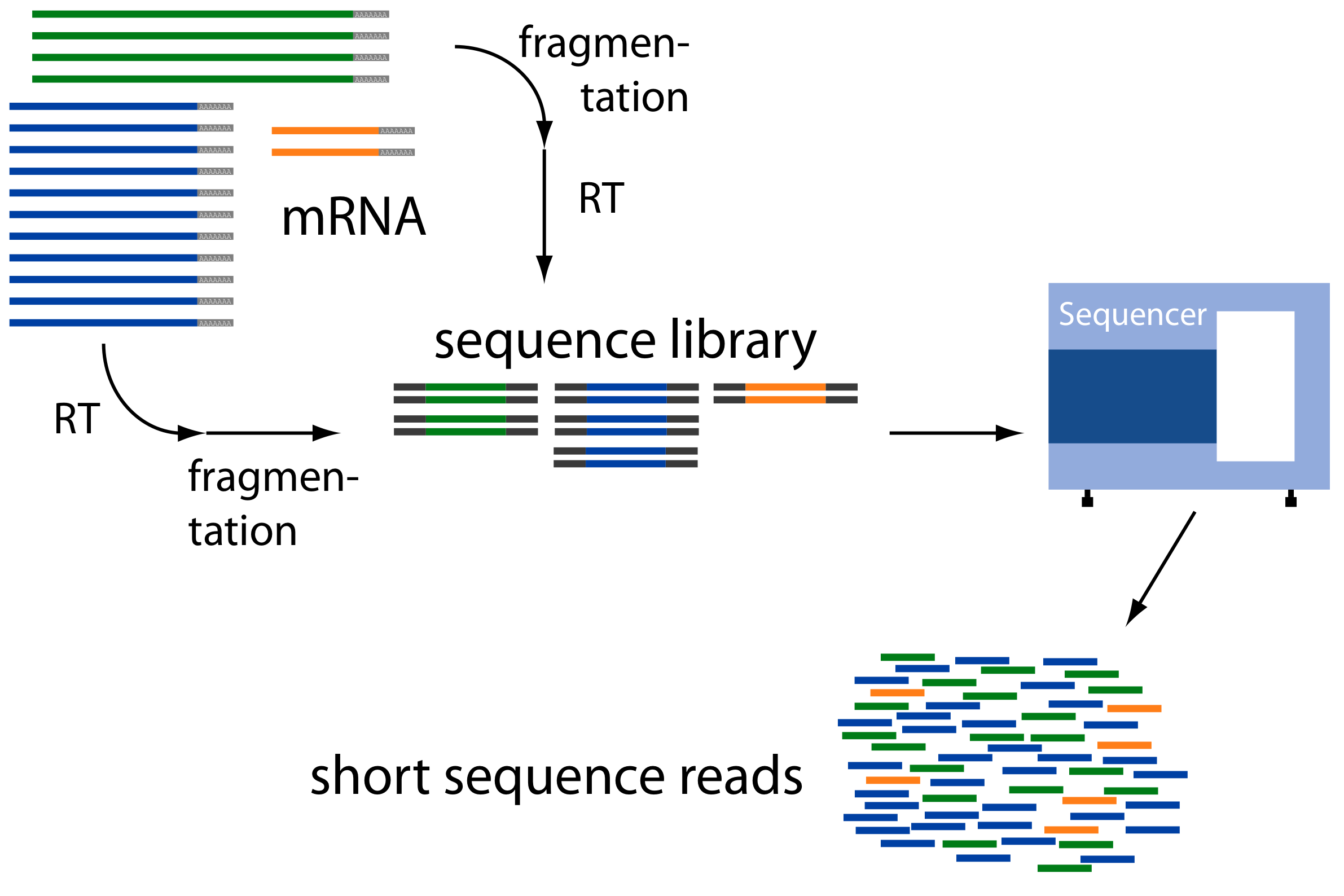
- Spliced Alignments for ESTs, cDNAs, and Next-Generation Sequencing Reads
-
Despite many years of research on how to properly align sequences in the presence of sequencing errors, alternative splicing and micro-exons, the correct alignment of mRNA sequences to genomic DNA is still a challenging task. We use large margin structured output learning to learn parameters which improve the accuracy of alignment tools. We have developed three tools for accurately and efficiently aligning EST and next-generation sequencing reads against a reference genome by taking advantage of additional information, such as splice site predictions and intron lengths. 
- Analysis of Whole-Genome Tiling Microarrays
-
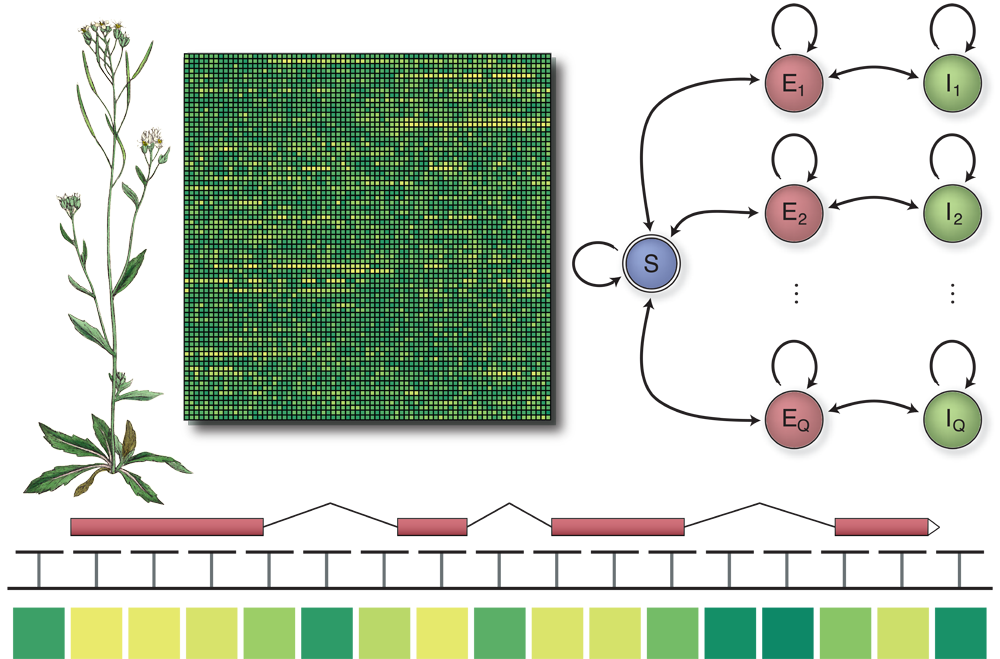
We have developed methods for normalization and segmentation of tiling array data with the aims to i) reduce probe sequence effects on hybridization intensity and ii) in comparison to existing methods more accurately segment transcribed exons out of the intergenic/intronic background.
In collaboration with Detlef Weigel's group, we applied our novel computational tools to analyze whole-genome tiling array data from 11 Arabidopsis tissues and developmental stages as well as 5 abiotic stress treatments. We discovered thousands of new transcripts, undetected by previous annotation efforts, including ones that show significant expression changes under stress.
- RNA Secondary Structure Prediction
-
In this project we are interested in the secondary structure of a given RNA nucleotide sequence. Formally we are interested in predicting a planar graph from a string sequence. Even though there exists already a lot of algorithms dealing with this problem one can not consider it to be solved since even the current (2009) best approaches achieve error rates in the number of predicted pairs of about 25%. There is evidence that misfolding in even 2% of pairs or a molecule can lead to severe diseases in human and other organisms. We try to use machine learning methods to obtain more accurate structure predictions. 
- Eukaryotic Gene Regulation
-
We develop methods to predict the regulation of genes through transcription factors (TF) from the euchromatic sequence of co-regulated genes in eukaryotes. We look for overrepresented, putative binding motifs of TFs, exploiting the facts that (i) many eukaryotic genes have a homolog in related species and binding motifs are thus conserved; (ii) many transcription factors exhibit a positional preference when binding in a regulatory region; and (iii) most genes are controlled by a combination of factors with their corresponding binding sites forming homotypic or heterotypic clusters known as cis-regulatory modules. 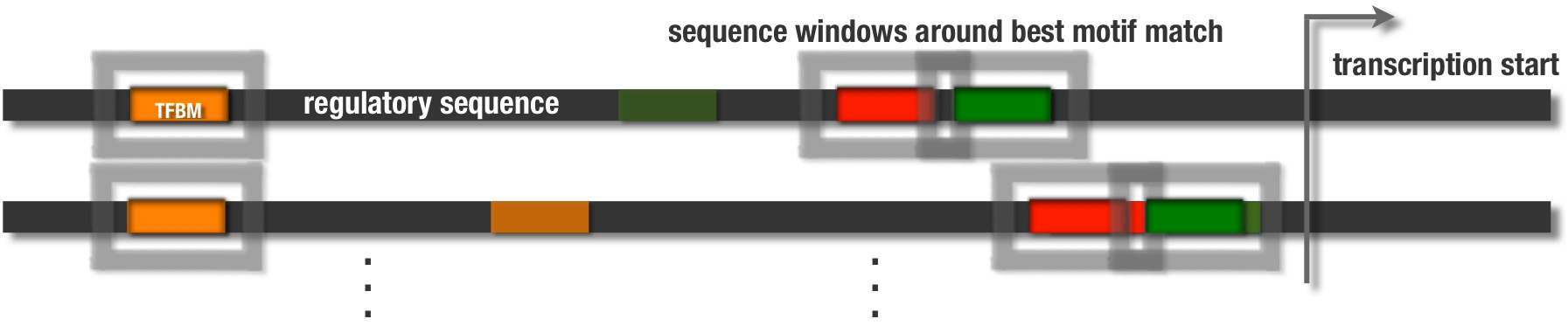
Publications
-
Jean, G, Kahles, A, Sreedharan, VT, De Bona, F, and Rätsch, G (2010).
RNA-Seq Read Alignments with PALMapper
Curr. Protoc. Bioinform., 32:11.6.1- 11.6.37.
 Printable file
-
Schultheiss, SJ, Busch, W, Lohmann, JU, Kohlbacher, O, and Rätsch, G (2009).
KIRMES: Kernel-based identification of regulatory modules in euchromatic sequences
Bioinformatics, 25(16):2126-2133.
http://bioinformatics.oxfordjournals.org/cgi/content/full/25/16/2126
Printable file
-
Naouar, N, Vandepoele, K, Lammens, T, Casneuf, T, Zeller, G, van Hummelen, P, Weigel, D, Rätsch, G, Inzé, D, Kuiper, M, De Veylder, L, and Vuylsteke, M (2009).
Quantitative RNA expression analysis with Affymetrix Tiling 1.0R Arrays identifies new E2F target genes
Plant Journal, 57(1):184-194.
Printable file
-
Zeller, G, Henz, SR, Widmer, CK, Sachsenberg, T, Rätsch, G, Weigel, D, and Laubinger, S (2009).
Stress-induced changes in the Arabidopsis thaliana transcriptome analyzed using whole genome tiling arrays
Plant Journal, 58(6):1068-1082.
http://www.weigelworld.org/resources/microarray/at-tax
Printable file
-
Zeller, G, Henz, S, Laubinger, S, Weigel, D, and Rätsch, G (2008).
Transcript Normalization and Segmentation of Tiling Array Data
In: Pacific Symposium on Biocomputing, vol. 13, pp. 527-538, Stanford, World Scientific.
http://www.fml.tuebingen.mpg.de/raetsch/projects/PSBTiling
Printable file
-
Laubinger, S, Sachsenberg, T, Zeller, G, Busch, W, Lohmann, J, Rätsch, G, and Weigel, D (2008).
Dual roles of the nuclear cap binding complex and SERRATE in pre-mRNA splicing and microRNA processing in Arabidopsis thaliana
PNAS, 105(25):8795-8800.
Printable file
-
Laubinger, S, Zeller, G, Henz, S, Sachsenberger, T, Widmer, C, Naouar, N, Vuylsteke, M, Schölkopf, B, Rätsch, G, and Weigel, D (2008).
At-TAX: a whole genome tiling array resource for developmental expression analysis and transcript identification in Arabidopsis thaliana
Genome Biology, 9:R112.
http://www.weigelworld.org/resources/microarray/at-tax
Printable file
-
De Bona, F, Ossowski, S, Schneeberger, K, and Rätsch, G (2008).
QPALMA: Optimal Spliced Alignments of Short Sequence Reads
In: Bioinformatics/Proc. ECCB'08, Oxford University Press.
http://www.fml.tuebingen.mpg.de/raetsch/projects/qpalma
Printable file
-
Schulze, U, Hepp, B, Ong, CS, and Rätsch, G (2007).
PALMA: mRNA to Genome Alignments using Large Margin Algorithms
Bioinformatics, 23(15):1892-1900.
http://bioinformatics.oxfordjournals.org/cgi/content/full/23/15/1892
Printable file
